
Why the Universal Balm is not vegan
There is beeswax in the balm, so it is not vegan. What the beeswax is doing, what would replace it, and why I have not made the swap.

There is Manuka beeswax in the Universal Balm. Beeswax comes from bees, so the balm is not vegan, and I say so on the page rather than leaving people to work it out from the ingredient list.
The obvious question is why not swap it for a wax that is not. This is where I have landed and why.
First, a thing about the word
Green Glow is not a vegan brand and I do not describe it as one. Seed Glow happens to contain no animal-derived ingredients. The balm contains beeswax. Those are two separate facts about two separate products.
Plenty of brands would take the first fact and stretch it across the whole range, or lean on softer words that imply it without saying it. I would rather tell you which product is which. A claim that is true of one thing is not a claim you get to make about everything.
What the beeswax is actually doing
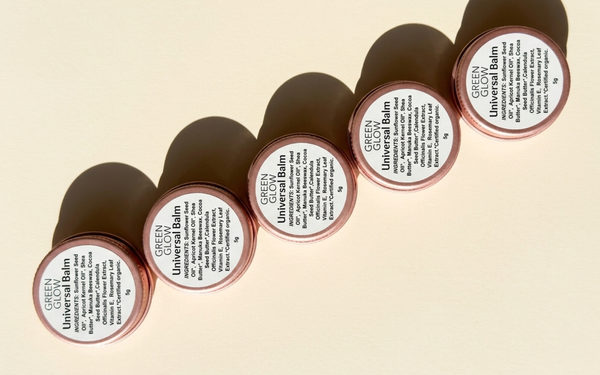
The balm is eight ingredients: unrefined organic shea and cocoa seed butter, unrefined organic sunflower and apricot kernel oil, Manuka beeswax, calendula, vitamin E and rosemary extract. That is the whole list.
It is also waterless, which shapes everything. There is no water phase, so there is no emulsion to hold together and nothing for microbes to live in, which is why there is no preservative in it. That is a consequence of the format, not an achievement.
In that kind of formula, the wax is doing two jobs at once.
It gives the balm its structure. Butters and oils alone will not hold a stable solid across an Australian temperature range. Beeswax raises the melt point so the balm stays a balm in a Melbourne February and still softens on contact with skin.
It forms the occlusive film. This is the part that matters for what the balm is for. Beeswax sits on the surface and slows water loss without sealing skin completely, which is the behaviour you want on cracked hands, split cuticles or a wind-stripped face. I went through the mechanics of that in occlusive, emollient, humectant, and the practical version in how to fix cracked hands and split cuticles.
What I would have to use instead
There are real alternatives.
Candelilla wax is the usual substitute. It is harder than beeswax, so you use less, and it gives a firmer, glassier balm with a slightly draggier feel on skin. It works. It is not the same.
Carnauba wax is harder again, and pushes the texture further from where I want it.
Rice bran and sunflower waxes are gentler options and behave more like beeswax in some respects, though they are fussier about how they set.
None of these is a bad ingredient. If I were formulating a vegan balm from scratch, candelilla is where I would start.
The honest problem is that I am not formulating from scratch. Swapping one component out of a finished formula and keeping everything else identical is not how a balm works. Change the wax and you change the melt point, the slip, the way it sits on skin and how long it stays there. What comes out the other side is a different product wearing the same label.
So why not just make the different product
This is the part where I could give you a principled answer and it would not be true.
The truthful answer is that it would mean two balms, two sets of trials, two stock lines and two things to get wrong, from an operation where two people make everything by hand. I am not able to do that well right now, and I would rather do one thing properly than two things adequately.
If the range grows to the point where a second balm is realistic, a vegan version is genuinely on the list. I am not going to promise a date, because I do not have one.
What I will not do
I will not quietly reformulate and leave the packaging as it is.
I will not describe the brand as vegan because one product happens to be.
And I will not use "botanical" as a way of implying it without saying it. That word gets stretched a long way in this industry, and I have written about how far the language can bend in what skincare claims actually mean.
If the beeswax is a dealbreaker for you, I would genuinely rather you bought Seed Glow, or bought nothing, than felt misled by a word.
Common questions
Is Seed Glow vegan?
It contains no animal-derived ingredients. It is a blend of cold-pressed botanical oils. I do not carry a certification, so I describe the contents rather than making a certified claim.
Where does the beeswax come from?
It is Manuka beeswax. Sourcing is the honest limit of what I can verify at my scale, and I set out exactly where those limits fall in where our ingredients come from.
Will beeswax block my pores?
It is a surface occlusive rather than something that sinks in, and most people use it without trouble. Skin is individual though, so patch test properly before you commit it to your face.
Is a balm even the right thing for me?
Not necessarily. Balm, oil or moisturiser goes through which one your skin is actually short of.
Continue reading
- What "small batch" and "handmade" actually mean
- Where our ingredients come from
- Occlusive, emollient, humectant: which one your dry skin actually needs
Built on the ideas in this post.
Ingredient transparency, handmade in Melbourne. The same care that goes into how we write goes into how we formulate.
Shop Universal Balm →
Kapha season
Waterless, and what that choice costs
Abhyanga: what oiling your own skin actually does
Join the community
Slow beauty, in your inbox
Ritual guides, ingredient stories and 15% off your first order, for those who believe the best skincare comes from nature.
We respect your privacy. Unsubscribe at any time.

Let nature show its magic to you. Naturally derived skincare rooted in Ayurveda, handmade in small batches in Melbourne for sensitive, dry and ageing skin.