
How to fix cracked hands and split cuticles
Why hands crack and cuticles split in winter, why hand cream keeps failing, and the overnight routine that actually repairs them.

Hands are the part of the body we treat worst and expect the most from. They get washed a dozen times a day, dried on whatever is nearest, put into cold air wet, and then handed a pump of scented lotion once in a while as compensation. By the middle of winter the skin around the nails splits, the knuckles go tight and shiny, and one crack opens near a thumb and refuses to close.
Here is why that happens and what actually shifts it.
Why hands crack when the rest of you does not
The skin on the backs of your hands is thin, and it has very few oil glands compared with your face. It does not make much of its own protection, so almost all of its defence is the lipid layer sitting on the surface, and that layer is water soluble in the presence of detergent.
Every hand wash removes some of it. Hot water removes more. Hand sanitiser removes a great deal. Cold outdoor air then pulls water out of the unprotected surface, and indoor heating does the same thing from the other direction, because heated air holds less humidity. So hands are being stripped and then dried, repeatedly, all day.
Cuticles fail first because that skin is thinnest of all and because it is under mechanical stress every time you use your hands. Once it dries out it loses flexibility, and inflexible skin at a stress point splits. That is not a nail problem. It is a moisture problem in a very small piece of skin.
Why your hand cream keeps not working
Three reasons, and they are all fixable.
It is mostly water. Most hand creams are an emulsion, which means they are largely water with some oil in them. Water evaporates. Within about twenty minutes you are left with a thin residue of whatever else was in the tube, which on a heavily stripped hand is not much.
You wash it off. You apply cream, then wash your hands forty minutes later, and you are back to the beginning. Applying more often is not the answer if it keeps coming off.
It is fragranced. Fragrance is the most common cause of contact irritation in skincare, and on already cracked skin it has a direct route in. If your hands sting when you moisturise them, that is worth paying attention to.
The routine that actually repairs hands
The principle is simple. Repair happens overnight, because that is the only long uninterrupted stretch when nothing is being washed off. Daytime is about damage limitation.
Overnight, every night until it settles
- Wash and pat hands so they are barely damp, not dry.
- Apply a hydrating layer if you have one. A few drops of a face oil works perfectly well here and is not a waste.
- Warm a small amount of balm between your palms and work it over the backs of the hands, into each knuckle, and around every nail bed. Spend a moment on the cuticles specifically, pinching a little balm around each one.
- If a crack is open, put a slightly heavier layer directly on it. Cotton gloves over the top help, but they are optional.
- Sleep.
Most people see a real difference in three or four nights. A deep split near a nail takes longer, closer to a week or two, because the skin has to knit back together and it keeps getting used.
Through the day
- Turn the water temperature down. Warm, not hot.
- Pat dry rather than rubbing, and do not leave hands damp in cold air.
- Reapply a small amount of balm after the last hand wash before you leave the house, and again mid afternoon if you are outdoors.
- Wear gloves for washing up and for cold weather. This is dull advice and it is the single most effective thing on this list.
Why a waterless balm suits hands better than a cream
There is no water in a balm to evaporate, so what you apply is what stays. It also does not absorb and disappear in the way a lotion does, which sounds like a downside until you understand that the sitting on top is the point. That layer is what stands between stripped skin and cold air.
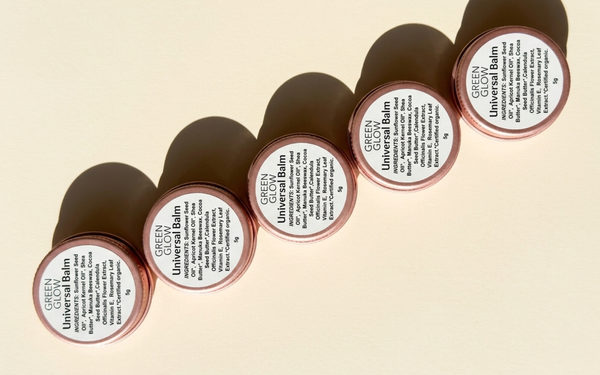
Our Universal Balm is concentrated and waterless, which is why a 15g tin lasts far longer than it looks like it should. It is made with organic shea and cocoa seed butters, sunflower and apricot kernel oils, manuka beeswax, calendula, and vitamin E, and it has no added fragrance at all. On hands, the beeswax content is doing most of the work: it holds a flexible film over the skin that survives being used.
The small tin is the one to keep in a bag or a coat pocket. The larger jar stays by the bed for the overnight step.
A note on honesty: it contains beeswax, so it is not vegan. And if your hands are cracked to the point of bleeding, weeping, or showing signs of infection, that is past the point where a cosmetic balm is the right answer. See a pharmacist or your GP.
Common questions
How long until cracked hands heal?
Three to four nights of consistent overnight treatment for general dryness. One to two weeks for a deep split, provided you stop re-stripping it during the day.
Can I use the same balm on my cuticles and my face?
Yes. It is the same formula and the same job. Cuticles just need it more often.
Will it feel greasy?
It will feel like a layer, because it is one. Warming it between your palms first and using less than you think makes the difference between a sheen and a smear.
Continue reading
- Why skin cracks in winter, and what actually stops it
- Slugging, without the petroleum jelly
- Occlusive, emollient, humectant: which one your dry skin actually needs
Built on the ideas in this post.
Ingredient transparency, handmade in Melbourne. The same care that goes into how we write goes into how we formulate.
Shop Universal Balm →
Kapha season
Waterless, and what that choice costs
Abhyanga: what oiling your own skin actually does
Join the community
Slow beauty, in your inbox
Ritual guides, ingredient stories and 15% off your first order, for those who believe the best skincare comes from nature.
We respect your privacy. Unsubscribe at any time.

Let nature show its magic to you. Naturally derived skincare rooted in Ayurveda, handmade in small batches in Melbourne for sensitive, dry and ageing skin.