
Slugging, without the petroleum jelly
What slugging is, what it genuinely does for dry skin, and how to do it with a plant based balm instead of petroleum jelly.

Slugging has been called a trend for about four years, which is usually the point at which a thing stops being a trend. The name is unfortunate. The idea underneath it is old, sound, and worth understanding properly before you decide whether it belongs in your routine.
What slugging actually is
Slugging means applying a thin layer of an occlusive product as the last step of your evening routine, over the top of everything else you have already used. That is the entire method. There is nothing more to it.
The important part is what an occlusive does, because it is not what most people assume. An occlusive layer does not moisturise your skin. It cannot. It sits on the surface and slows the rate at which water evaporates out of the skin overnight. That water loss has a name, transepidermal water loss, and it happens constantly, all day and all night, whether or not you are thinking about it. Slugging simply slows it down for eight hours.
This is why slugging works well over a hydrating step and poorly over nothing. If there is no water in the skin to hold, sealing the surface has very little to hold in.
Does it actually work, or is it just the internet?
It works, for the specific thing it does.
Reducing evaporation from the surface of the skin is one of the most reliably understood mechanisms in skincare. It is the reason a barrier ointment helps a chapped lip, and it is the reason skin feels different the morning after. You wake up and the tightness is gone, the flakes have softened, and makeup sits better.
What slugging will not do is worth saying just as plainly. It will not resurface anything. It will not fade pigmentation, treat acne, or firm anything. It is a holding step, not an active one. Anyone selling it as a transformation is selling you something.
If your skin is dry, tight, flaking, wind exposed, or recovering from a course of strong actives, slugging is one of the highest value things you can do and it costs you thirty seconds. If your skin is comfortable and balanced already, you may notice very little, and that is a perfectly good reason to skip it.
Petroleum jelly works. It is just not the only option.
Honesty first, because it matters more than the sale: petroleum jelly is an extremely effective occlusive. It blocks close to all water loss from the surface, it is cheap, and it is about as unreactive as a cosmetic ingredient gets. If it suits you, it suits you.
The reasons people look for something else are usually these. It sits entirely on the surface and contributes nothing the skin can actually use. It feels heavy and slides onto your pillow. It has no other function, so it is one more single purpose thing in the cupboard. And some people simply prefer their skincare to come from plants, which is a preference, not a scientific position, and does not need defending.
A balm built on plant butters and wax behaves differently. It is slightly less occlusive than petroleum jelly, so it breathes a little more and feels less like a film. In exchange, the fatty acids in shea and cocoa butter and the vitamin E carried in the oils are materials the skin recognises and can work with. You get most of the sealing, plus something else. That trade is the whole argument, and it is a reasonable one either way.
How to slug with a balm
- Cleanse and leave skin slightly damp. Not dripping. Damp. You are giving the seal something to hold.
- Apply your hydrating step. A serum, an essence, or a face oil. This is the part that actually brings water and lipids to the skin.
- Warm a small amount of balm between your fingertips. A waterless balm is solid in the jar and melts at skin temperature. Warming it first is the difference between a sheer layer and a thick smear.
- Press, do not rub. Press it over the areas that need it. For most people that is the cheeks, around the nose, and anywhere flaking.
- Leave it overnight. Rinse in the morning if you prefer, or simply cleanse as normal.
Once or twice a week is enough for most skin. Every night is fine through a bad winter stretch or after wind exposure.
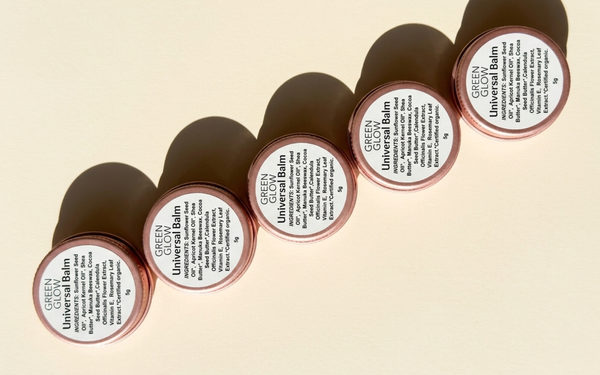
Our Universal Balm was built for exactly this step. It is waterless and concentrated, so a very small amount covers a lot, and it is made with organic shea and cocoa seed butters, sunflower and apricot kernel oils, manuka beeswax and calendula. There is no added fragrance in it, which matters more than it sounds when you are putting something on compromised skin and leaving it there all night. It contains beeswax, so it is not vegan, and we would rather say that plainly than let you find out later.
Who should not slug
- If you are actively breaking out, be cautious. Sealing a congested area is not always helpful. Slug the dry parts and leave the rest.
- If you are using retinoids or acids that night, do not layer an occlusive over the top. It can increase how strongly they act on the skin. Alternate nights instead.
- If your skin is oily and comfortable, you probably do not need this. Slugging solves dryness. It is not a general upgrade.
Common questions
Do I need to slug every night?
No. Once or twice a week suits most people. Nightly is reasonable during a cold, windy stretch or while a barrier is recovering.
Will it clog my pores?
An occlusive traps whatever is underneath it, so what matters most is that the skin and the products beneath are clean and suitable for you. If you are prone to congestion, keep slugging to the dry areas rather than the full face.
Can I use it on my lips?
Yes. Lips have almost no barrier of their own and are the single best place to start if you want to see what occlusion does.
Is it safe during pregnancy or breastfeeding?
Our balm is made from all natural ingredients with no added fragrance. As with any new skincare product, check the full ingredient list against your own allergies and speak to your healthcare professional first.
Continue reading
- Occlusive, emollient, humectant: which one your dry skin actually needs
- Why skin cracks in winter, and what actually stops it
- Balm, oil or moisturiser: what to use, and when
Built on the ideas in this post.
Ingredient transparency, handmade in Melbourne. The same care that goes into how we write goes into how we formulate.
Shop Universal Balm →
Kapha season
Waterless, and what that choice costs
Abhyanga: what oiling your own skin actually does
Join the community
Slow beauty, in your inbox
Ritual guides, ingredient stories and 15% off your first order, for those who believe the best skincare comes from nature.
We respect your privacy. Unsubscribe at any time.

Let nature show its magic to you. Naturally derived skincare rooted in Ayurveda, handmade in small batches in Melbourne for sensitive, dry and ageing skin.