
Waterless, and what that choice costs
Both my formulas are waterless. That is why neither has a preservative, and it is a consequence of the format rather than an achievement. What it gets you, and what it costs.

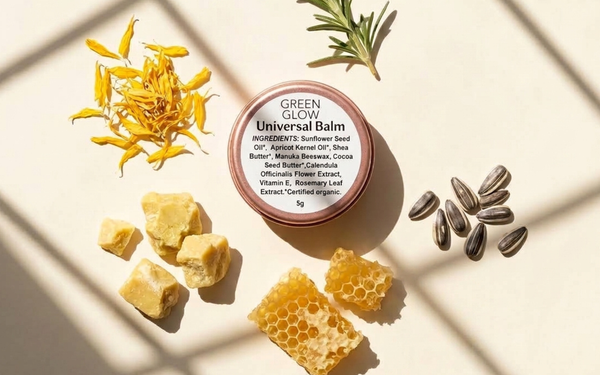
Neither of my formulas contains water. Seed Glow is a blend of cold-pressed oils. The Universal Balm is butters, oils and wax, melted and poured.
This is the single decision that shapes everything else about how they are made, and it is the one I get the least accurate credit for. So here is what waterless actually means, what it genuinely buys you, and the parts of it that are a straight loss.
What waterless means
The technical word is anhydrous. No water phase, at all.
Most skincare is mostly water. Turn over a serum or a moisturiser and aqua will almost always be the first ingredient, which means it is the largest by weight. That is not a scandal. Water is the vehicle that lets a formula carry humectants, spread thinly, sink in fast and feel light.
An anhydrous formula gives all of that up.
Why there is no preservative in either
This is the part that gets misread most often, so I want to be exact.
Bacteria, yeast and mould need water to grow. Take the water out and there is nothing for them to live in. So an anhydrous formula does not need a preservative system, because there is no water phase to preserve.
That is a consequence of the format. It is not a virtue, and it is not something I achieved.
I am labouring this because "preservative free" is one of the most misleading phrases in the industry. On a waterless balm it is a description. On anything containing water it should make you deeply suspicious, because a water-containing product without adequate preservation is not purer, it is a microbiology problem waiting to happen. Preservatives are a safety feature, which is why they were the first thing I defended in the ingredient decoder.
What waterless genuinely gets you
Concentration. Every drop is the active material. There is no 70 per cent water for the oils to be suspended in, so a small bottle goes a surprisingly long way. Three or four drops covers a face.
A simpler formula. No water means no emulsifier to hold oil and water together, no preservative system, no pH to balance. Eight ingredients in the balm is not minimalism as a marketing position. It is what the format allows.
Fewer things to react to. For skin that is already reactive, a shorter list is a smaller surface area for trouble. That was not the goal, but it was the reason I ended up here, since I was formulating for my own skin.
Stability of a different kind. Nothing to split, nothing to separate, no emulsion breaking in a hot car.
What it costs
This is the half most waterless brands leave out.
You cannot deliver humectants properly. Glycerin, hyaluronic acid and urea work by holding water. With no water phase, there is nothing for them to work in. So an anhydrous formula can only do two of the three jobs skin needs, and the third has to come from somewhere else. In practice that means damp skin, which is why I keep saying apply it damp, and why occlusive, emollient, humectant is the piece I most want people to read.
The texture is not for everyone. Oils and balms feel like oils and balms. If you want something that vanishes in four seconds, this is not it, and no amount of formulating will make an anhydrous product behave like a gel-cream.
Oxidation replaces microbial spoilage as the enemy. Nothing will grow in the bottle, but the oils will go rancid eventually. That is why Seed Glow has a six-month period after opening, which is short, and deliberately so. Oils that have kept their nutrient content are the ones most reactive to oxygen. Storage genuinely matters, and I went through it in when skincare actually goes off.
The discipline runs the other way. A water-based operation guards against microbial growth. Mine guards against water getting in. Wet fingers in a balm jar, a bathroom shelf above a shower, a lid not properly on. Introduce water into an unpreserved anhydrous product and you have created exactly the problem the format was avoiding.
And it limits the range. There is no waterless cleanser worth having, no waterless toner, no waterless anything-light. Choosing this format meant choosing not to make most categories.
Why I chose it anyway
Less nobly than the above might suggest.
I needed something my own skin would tolerate, and every route I could see to that ran through fewer ingredients rather than more. Anhydrous was the format that let me use unrefined, cold-pressed materials at meaningful concentrations without needing a laboratory, a preservative challenge test and a microbiology budget I did not have.
It was the right format for what I could do properly. It was also, if I am honest, the format that a small maker can execute safely, which is a real part of why so many of us start here. I said the same thing about small batch in this piece: an anhydrous balm is far more forgiving than an emulsion, and pretending otherwise would be flattering myself.
What this does not mean
It does not mean water in skincare is bad. It is the most useful ingredient in cosmetic chemistry.
It does not mean preservative-free is safer. On a water-containing product it is the opposite.
It does not mean an oil is all your skin needs. Most skin does better with a humectant step underneath, and that step will contain water.
And it does not make anything I sell medical. Persistent skin conditions belong with a GP or dermatologist.
Common questions
If there is no preservative, how long does it last?
Check the period-after-opening symbol on the base and write the month you opened it on the jar. Seed Glow is six months. The limit is oxidation, not contamination.
Can I use a face oil on its own?
You can, and plenty of people do. But an oil is an occlusive and an emollient, not a humectant, so it works better over damp skin or over something water-based. Face oil vs moisturiser goes through when you want both.
Why does the balm sometimes feel harder or softer?
Temperature, mostly. Unrefined butters also vary by harvest, which is a trade-off of using them unrefined.
Can I get water in the jar?
Try not to. Dry hands, lid on, and keep it off the shelf directly above the shower.
Continue reading
- Ten ingredient names that sound alarming, and what they actually do
- What "small batch" and "handmade" actually mean
- When skincare actually goes off, and how to store it
Built on the ideas in this post.
Ingredient transparency, handmade in Melbourne. The same care that goes into how we write goes into how we formulate.
Shop Seed Glow Face Oil →
Kapha season
Abhyanga: what oiling your own skin actually does
Why the Universal Balm is not vegan
Join the community
Slow beauty, in your inbox
Ritual guides, ingredient stories and 15% off your first order, for those who believe the best skincare comes from nature.
We respect your privacy. Unsubscribe at any time.

Let nature show its magic to you. Naturally derived skincare rooted in Ayurveda, handmade in small batches in Melbourne for sensitive, dry and ageing skin.