
Where our ingredients come from, and what "ethically sourced" is allowed to mean
Sustainably sourced, ethically made and carbon neutral are mostly undefined terms. What each one has to be backed by, and exactly what we can and cannot verify about our own.

"Sustainably sourced" appears on an enormous number of products and means, on its own, nothing enforceable. Neither does "ethically made", "responsibly sourced" or, most of the time, "eco-friendly". They are good intentions written in a font.
We use some of these ideas ourselves, so the fair thing is to explain what the words are allowed to mean, then say exactly what we can and cannot verify about our own.
The green claims, and what backs them
| The claim | What it can mean | What to look for instead |
|---|---|---|
| Sustainably sourced | Anything from a rigorous certified supply chain to a supplier saying so on an email | A named certification, or a named farm or cooperative |
| Ethically sourced | Same. Not a defined term | Named standard, or a specific description of the relationship |
| Natural / eco / green | A positioning choice, not a standard | The ingredient list |
| Carbon neutral | Usually offsets purchased, not emissions avoided | Whether they say reduced or offset, and who verified it |
| Recyclable | The material can be recycled somewhere | Whether it is kerbside recyclable where you live, which is a different question |
| Recycled content | Actual recycled material in the packaging, usually a percentage | The percentage, which is the whole claim |
| Plastic-free | No plastic in the main container | Whether that includes the liner, seal, pump and outer wrap |
| Cruelty-free | Not tested on animals. Genuinely meaningful, and in Australia cosmetic animal testing is banned | Whether it is a certification or a self-claim |
The pattern is the same one as with claims on the front of the box: the specific is checkable and the sweeping is not. "Recyclable" is a claim about the universe. "43% post-consumer recycled glass" is a claim about the thing in your hand.
Recyclability deserves the extra flag. Kerbside systems vary by council, small components rarely get recycled even when the material technically can be, and mixed-material packaging, a pump with a metal spring in a plastic housing, usually cannot be separated at scale. A product can be honestly labelled recyclable and still, realistically, go to landfill.
What we can actually verify about ours
Here is the specific version, with the gaps left visible rather than filled in with warm language.
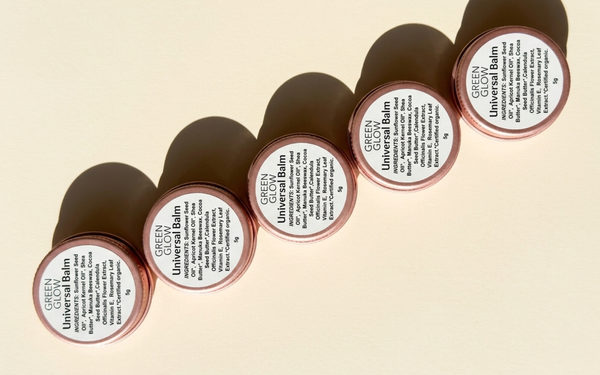
The Universal Balm butters and oils. The shea butter and cocoa seed butter are unrefined, certified organic, and sourced from Ghana. The sunflower and apricot kernel oils are unrefined and certified organic too. Unrefined matters here: it means the material has not been heat-treated and bleached, so it keeps its colour, its smell and its minor components. It also means slight variation between batches, which is what unrefined material does.
What we do not claim about the balm. We say unrefined rather than cold-pressed for these oils, because cold-pressing is confirmed for the Seed Glow oils and has not been confirmed for the balm's. It would be an easy claim to make and we have not made it. Details on why the distinction matters are in why cold-press matters.
The beeswax. Manuka beeswax, which is animal-derived, which is why the balm is not vegan. We say that plainly wherever the balm appears, because it is the kind of thing people need to know before they buy rather than after.
Seed Glow Face Oil. Sixteen cold-pressed oils, every one plant-derived, so it is genuinely vegan. It contains macadamia and sweet almond oil, so it is not suitable with a tree-nut allergy.
The Kansa wand. Bell metal, an alloy of copper and tin, handcrafted by artisan makers in India, which is where the tool and the tradition both come from.
Made in Melbourne, in small batches, by us. That one is easy to verify because it is where we are.
What we have not sorted out yet
A short list is more honest than a page of intentions.
We do not hold a third-party sustainability certification. We have not measured our carbon footprint, so we do not make a carbon claim in either direction. And we are not going to describe our packaging as recyclable until we can say which parts, in which bins, in which councils, because a vague version of that claim is the exact thing this post is complaining about.
Being a two-product operation in Melbourne means some of this is simply out of reach for now. Saying so seems better than borrowing the language of companies that have done the work.
What this will not do
None of this tells you whether a product suits your skin. Sourcing is an ethical and quality question, not a compatibility one, and beautifully sourced shea butter can still be wrong for your face.
It is also not an accusation. Plenty of brands using these terms are doing genuine work and simply lack a snappy way to say it. The problem is structural: the vague claim and the rigorous one look identical on a label, so the words stop carrying information for everyone.
Common questions
Is "cruelty-free" meaningful in Australia?
More than most of the others. Cosmetic animal testing is banned here, so the useful question is about ingredients tested overseas and whether the claim is certified or self-declared.
Does organic certification cover the whole product?
No. It applies to specific ingredients unless the finished product itself is certified. Check which is being claimed and by whom.
Is unrefined better than refined?
For barrier care, usually yes, because more of the minor components survive. Refined oils are more consistent and longer lasting, which are real advantages for other purposes.
Why not just get certified?
Cost and scale, honestly. Certification is priced for larger operations, and we would rather put the money into the formulas and tell you plainly where things come from.
Continue reading
- "Clinically proven" and other things the front of the box is allowed to say
- Natural vs synthetic skincare: what the words mean on a label
- Why cold-press matters
Built on the ideas in this post.
Ingredient transparency, handmade in Melbourne. The same care that goes into how we write goes into how we formulate.
Shop Seed Glow Face Oil →
Kapha season
Waterless, and what that choice costs
Abhyanga: what oiling your own skin actually does
Join the community
Slow beauty, in your inbox
Ritual guides, ingredient stories and 15% off your first order, for those who believe the best skincare comes from nature.
We respect your privacy. Unsubscribe at any time.

Let nature show its magic to you. Naturally derived skincare rooted in Ayurveda, handmade in small batches in Melbourne for sensitive, dry and ageing skin.