
"Clinically proven" and other things the front of the box is allowed to say
Most claims on the front of a skincare box are not regulated the way you think. What each one has to be backed by, and the questions that cut through them.

We spent a post on reading the back of the box, because the ingredient list is the part that has to be true. This is about the front, where the rules are looser and the language is doing a great deal of work.
Australian law does require claims to not be misleading, and the ACCC does act on that. But "not misleading" is a lower bar than "proven", and a surprising number of the phrases you see every day mean less than they sound like.
The claims, and what sits behind them
| The claim | What it usually means | What it does not mean |
|---|---|---|
| Clinically proven | Some study was run. It may have been eight weeks, twenty people, self-assessed, and funded by the brand | Peer reviewed, replicated, or compared against a control |
| Dermatologist tested | A dermatologist was involved in testing it, usually for irritation | That a dermatologist recommends it, or that it passed anything in particular |
| Dermatologist recommended | Some number of dermatologists surveyed said they would recommend it. The survey size is rarely on the box | A professional consensus |
| Hypoallergenic | The brand believes it is less likely to cause a reaction | Any defined standard. The term is not legally defined in Australia |
| Non-comedogenic | Usually based on old testing methods, sometimes on rabbit ears, sometimes on nothing | That it will not break you out. Pore-clogging is highly individual |
| Up to 90% saw improvement | A self-assessment questionnaire, where participants reported what they felt | Measured, instrumented, or blinded results |
| Natural / clean / green | A positioning choice | Any regulated standard. We covered this in natural vs synthetic |
| Chemical-free | Nothing. It is not a real category | Anything at all |
None of this means every brand making these claims is being dishonest. Plenty do real testing. The problem is that the phrase on the box reads identically whether the study behind it was rigorous or thin, so the claim itself carries almost no information.
The three questions that cut through it
You will not get an answer to these from the packaging, and asking them changes what you notice.
Compared to what? "Reduced dryness by 40%" against what baseline, and versus what alternative? A moisturiser that beats bare skin has proven very little. A moisturiser that beats another moisturiser has proven something.
Measured how? Instrument readings, or people ticking a box about how they felt? Self-reported improvement in an unblinded trial is close to a measure of expectation.
How many people, and for how long? Twenty participants over four weeks is a pilot. It is not nothing, and it is not proof.
The number problem
Percentages are where claims get slipperiest, because a percentage without its base is unreadable.
"90% of users saw an improvement in radiance" tells you nothing until you know that 90% of what, over how long, judged by whom. If it is ninety per cent of thirty people ticking "yes" on a form after four weeks of a free product they knew they were testing, that is a very different sentence.
A relative number can hide a tiny absolute one. A 50% improvement sounds enormous. If the measure went from 2 to 3 on a ten-point scale, it is 50% and it is also barely visible in a mirror.
What we say, and what we deliberately do not
Being on the receiving end of these rules is a good reason to be specific about our own.
We do not claim clinical proof for anything. We have not run clinical trials. Two products made in Melbourne in micro-batches do not come with a research budget, and saying so is more useful than implying otherwise.
We do not say hypoallergenic or non-comedogenic. Both would be unverifiable claims about how your particular skin behaves. The Seed Glow FAQ speaks to how the oil feels and absorbs, not to pores, and that wording is deliberate.
We do not make therapeutic claims. No treating, curing or healing anything. That is the line between a cosmetic and a medicine, and we stay on our side of it. Our products soothe, soften, seal and comfort, and those are the words we use because those are the things they do.
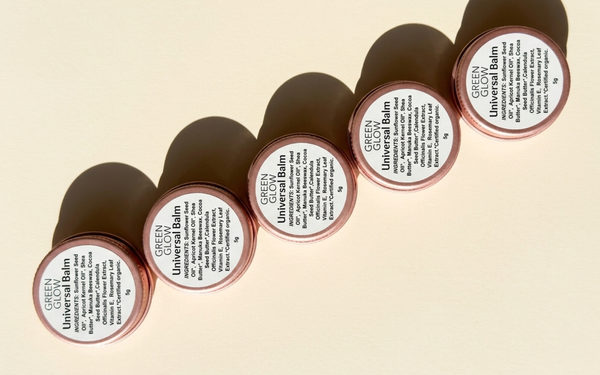
What we do claim is verifiable and specific. Waterless. Fragrance-free, meaning no parfum and no essential oils. Made in small batches in Melbourne. The shea, cocoa, sunflower and apricot kernel in the balm are unrefined and certified organic. The Seed Glow oils are cold-pressed, and we do not extend that claim to the balm's oils because we have not confirmed it. Seed Glow contains macadamia and sweet almond oil. The balm contains Manuka beeswax, so it is not vegan.
Those are all things you could check. That is roughly the test we try to apply: if a claim cannot be checked, it probably should not be on the label.
What this will not do
Being sceptical about claims is not the same as being sceptical about products. Plenty of well-marketed skincare works, and plenty of humbly-marketed skincare does not. The claim is not the product.
This also is not a guide to whether a specific ingredient works. Some actives have genuinely strong evidence behind them, retinoids and sunscreen chief among them, and dismissing everything as marketing gets you to a worse place than believing everything.
Common questions
Is "clinically proven" illegal if the study was small?
Not automatically. It has to not be misleading, which is a lower bar than most people assume. The size and quality of the study is usually not disclosed.
Does "dermatologist tested" mean it is gentle?
It means testing happened. It does not tell you the result, the method, or the standard applied.
Is non-comedogenic testing reliable?
Not especially. Much of the underlying methodology is old and does not translate well to how a finished formula behaves on a real face. Whether something breaks you out is individual.
So what should I trust?
The ingredient list, the concentration where it is disclosed, your own patch test, and whether a brand is specific rather than sweeping. Specificity is a decent proxy for honesty.
Continue reading
- How to read an ingredient list in sixty seconds
- Ten ingredient names that sound alarming, and what they actually do
- Natural vs synthetic skincare: what the words mean on a label
Built on the ideas in this post.
Ingredient transparency, handmade in Melbourne. The same care that goes into how we write goes into how we formulate.
Shop Seed Glow Face Oil →
Kapha season
Waterless, and what that choice costs
Abhyanga: what oiling your own skin actually does
Join the community
Slow beauty, in your inbox
Ritual guides, ingredient stories and 15% off your first order, for those who believe the best skincare comes from nature.
We respect your privacy. Unsubscribe at any time.

Let nature show its magic to you. Naturally derived skincare rooted in Ayurveda, handmade in small batches in Melbourne for sensitive, dry and ageing skin.