
How to read an ingredient list in sixty seconds
INCI lists are in a fixed order and follow rules once you know them. Five checks that tell you what a product is, what it is mostly made of, and what to avoid.

The back of a skincare bottle looks like a wall of Latin, which is exactly why most people read the front instead. The front is advertising. The back is regulated, and it follows rules that make it readable in under a minute once you know four of them.
The list is called the INCI, the International Nomenclature of Cosmetic Ingredients. Its whole point is that a product means the same thing on a shelf in Melbourne as it does in Milan.
Rule one: order is quantity, down to 1%
Ingredients are listed from most to least. That holds until you reach 1% of the formula, and after that a brand can list the remainder in any order it likes.
So the top of the list is the product. The bottom is a mixture of actives, preservatives and extras in unknown proportions.
The practical version: the first five ingredients are usually 70 to 80% of what is in the bottle. If the thing you are buying it for is not in that group, you are buying a small amount of it.
Rule two: find the 1% line
You cannot see it marked, but you can usually locate it, and it is the single most useful trick here.
Certain ingredients are almost always used below 1%: preservatives such as phenoxyethanol, sodium benzoate or potassium sorbate, plus xanthan gum, tocopherol, disodium EDTA, citric acid, and the fragrance allergens like linalool and limonene.
Find the first one of those. Everything after it is present at roughly 1% or less. If a hero botanical is sitting three places below the preservative, it is there for the label, not for your skin.
Rule three: aqua at the top is normal
Water is the first ingredient in most creams, serums and lotions, often 60 to 80% of them. That is not a con. Water is the vehicle that makes a lotion a lotion, and it is what humectants need in order to work.
It does mean two things worth knowing. A water-based product needs a preservative system, non-negotiably, and anyone selling you a water-containing product with no preservative is selling you something unsafe. And it means a waterless product is not comparable by volume. An oil or a balm with no water in it is entirely active material, which is why you use so much less of it.
Rule four: the names are not trying to trick you
Latin binomials look sinister and are just the plant's actual name, usually with the common name in brackets. Butyrospermum Parkii (Shea) Butter is shea butter. Helianthus Annuus (Sunflower) Seed Oil is sunflower oil. Tocopherol is vitamin E. Aqua is water.
Long chemical names are not a red flag on their own either. Sodium hyaluronate is hyaluronic acid, and it is the form your skin actually absorbs.
The sixty second version
- Read the first five. That is what the product mostly is.
- Find the first preservative or gum. Everything after it is 1% or less.
- Check where the hero ingredient sits. Above the line or below it.
- Scan for Parfum, Fragrance, or aromatic plant oils if your skin is reactive. More on why in fragrance-free vs unscented.
- Count the list. Not a quality measure, but a shorter list is easier to troubleshoot when something goes wrong.
Two lists, read out loud
Ours are short enough to print in full, which makes them a fair example.
Universal Balm, eight ingredients: sunflower seed oil, apricot kernel oil, shea butter, Manuka beeswax, cocoa seed butter, calendula extract, vitamin E, rosemary leaf extract. The first four are unrefined and certified organic.
Read it by the rules. No aqua, so it is waterless and needs no preservative. The first three are the oils and butter doing the softening. Beeswax at position four is high, which is what makes it seal rather than sink. Calendula, vitamin E and rosemary sit at the bottom, which is exactly where you would expect an extract and two antioxidants to be, and we are not going to pretend the calendula is doing the heavy lifting. The beeswax is animal-derived, so the balm is not vegan.
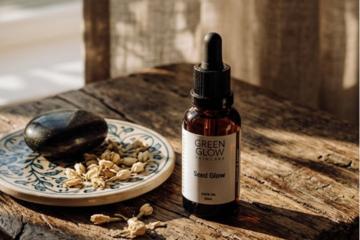
Seed Glow Face Oil, sixteen ingredients led by cold-pressed camellia, prickly pear, avocado, macadamia and pumpkin seed, with squalane, rosehip, marula and others behind them, finishing with saffron extract, Q10, vitamin E and rosemary. No water, no preservative, no fragrance. It is vegan, and the squalane comes from olives. It contains macadamia and sweet almond oil, so avoid it with a tree-nut allergy.
Neither list has a surprise in it. That is the point of learning to read them.
What this will not do
An ingredient list tells you what is in a product, not how well it was made. Concentration, quality, extraction method, freshness and formulation skill are all invisible on the label, and two products with near-identical lists can perform very differently.
It also will not tell you whether something suits you personally. That takes a patch test, and we wrote up how to do one properly.
Common questions
Does a longer list mean a worse product?
No. Some good formulas are long. Short lists are just easier to diagnose.
What if there is no ingredient list at all?
Do not buy it. In Australia, cosmetic ingredient labelling is a requirement.
Where do actives usually sit?
Often just above the 1% line. Most actives work at low percentages, so a low position is not automatically a problem. Position tells you quantity, not whether the quantity is right.
Is "fragrance" really one ingredient?
No. Parfum can stand for dozens of components that do not have to be listed individually.
Continue reading
- Natural vs synthetic skincare: what the words mean on a label
- Fragrance-free vs unscented: the label difference that matters
- Why cold-press matters
Built on the ideas in this post.
Ingredient transparency, handmade in Melbourne. The same care that goes into how we write goes into how we formulate.
Shop Seed Glow Face Oil
Why I formulate our products
Is Natural better than Synthetic ingredients
Why face oil all year round
Join the community
Slow beauty, in your inbox
Ritual guides, ingredient stories and 15% off your first order, for those who believe the best skincare comes from nature.
We respect your privacy. Unsubscribe at any time.

Let nature show its magic to you. Naturally derived skincare rooted in Ayurveda, handmade in small batches in Melbourne for sensitive, dry and ageing skin.